
On this page
Speed, cost direction, learning value, account exposure and the party restrictions that quietly decide the answer for you. A decision guide for the moment you are staring at the duo option in the configurator.
Two people can order the same rank on the same day and want opposite things from it. This guide is for the moment in the configurator when you are looking at the duo option and wondering whether it is worth the difference. No prices here, because prices move. This is about which one fits.
The two things being sold
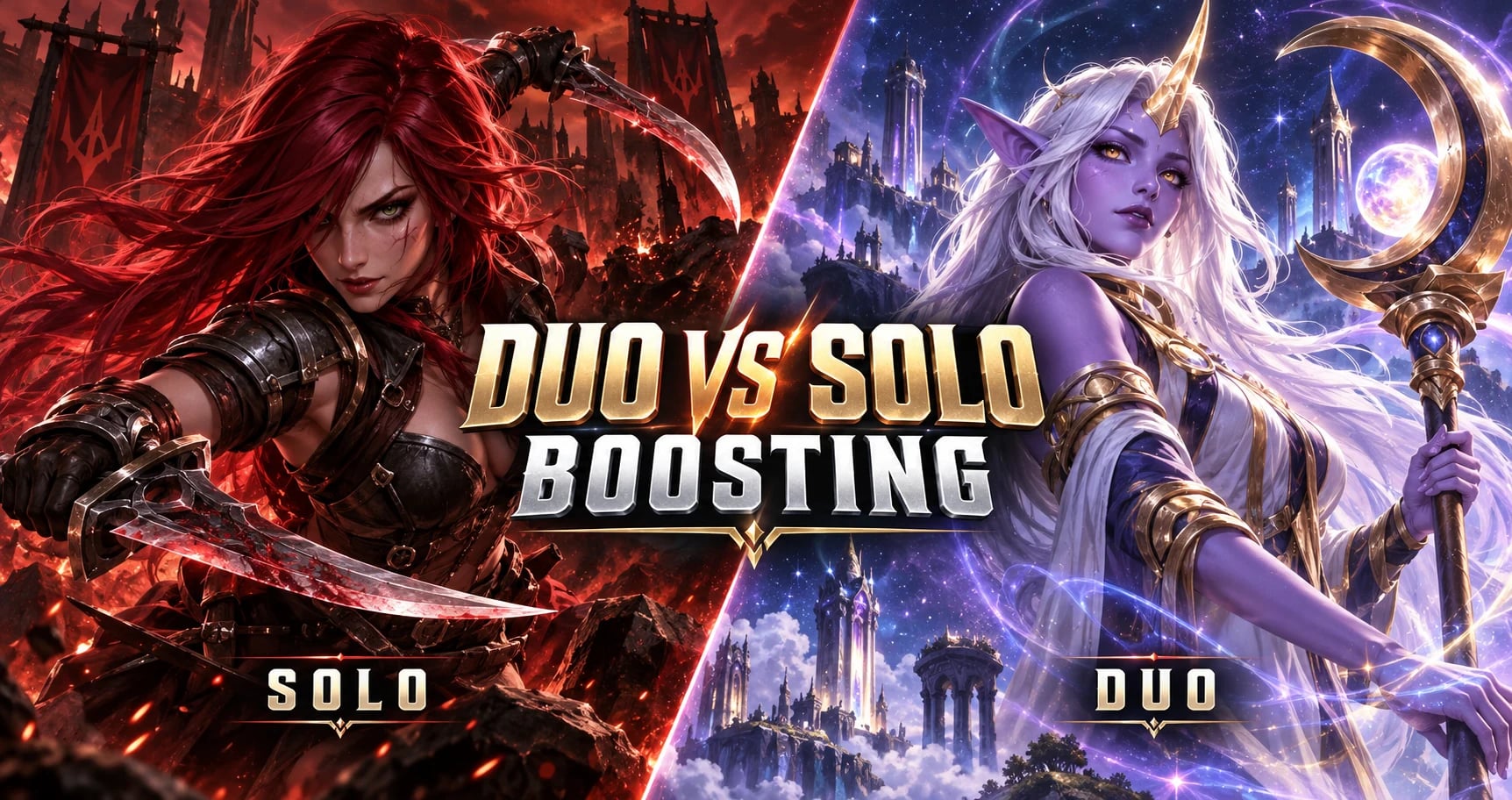
Solo boost
A vetted booster signs into your account and plays it to the target you set. You are not in the session. You watch progress from the dashboard, talk to the booster in the order chat, and the account's match history records games you did not play. Everything in this mode depends on the account-safety process rather than on you.
Duo queue
You play your own account and the booster queues with you, game after game, until the target is reached. Your login never changes hands. In titles with no competitive ladder the same option is usually called self-play: you drive your own character and the booster runs the group, calls the route or coaches live while it happens.
Speed and what it costs
Solo is faster, and the gap is wider than most people expect. Three reasons stack. The booster picks the hours, so the order runs whenever the queue is healthiest rather than whenever you are both free. The booster picks the role or character that carries hardest in the current patch instead of the one you are comfortable on. And in duo, half the team is by definition still playing at the rank you are trying to leave, which is a real handicap in every team game.
Duo also only moves while you are both online. An order that would take a booster two focused days can take a week of evenings when it depends on two calendars overlapping. If a season or a placement window is closing, that arithmetic decides the answer on its own.
Every provider prices duo above solo for the same target, ours included, and the reason is arithmetic rather than policy. The same target takes more games, and those games have to be scheduled around two people. The direction of that difference is stable even when the numbers move, so treat it as a fixed property of the choice.
What you actually learn
A solo boost teaches you nothing. That is not a criticism, it is the product: you bought an outcome, not a lesson. Duo is the only version where you finish the order playing better than you started it, and only if you use it that way. The players who get the most out of a duo order ask for the reasoning rather than the inputs. Why that rotation, why that timing, why give up this objective, are all questions with transferable answers. Settings and sensitivities are not.
Booster tip: in game one, tell your booster the two habits you want called out, and then let them call you out mid-match. A booster told nothing plays to win and says nothing, which is the correct default and the least useful version of the order you paid for.
Safety and account exposure
Duo removes the account-access question completely. Nobody signs into your account, no credentials change hands, your location and device never move, and your behavioural profile keeps being yours. A solo order carries the precautions we publish on the safety page and they work, but they are precautions against a category of risk a duo order never creates in the first place. If the account is old, carries purchases or is the only identity you play under, weigh that heavily.
Rank gaps and party restrictions, by game family
This is the constraint that decides the answer more often than preference does. Nearly every competitive game limits who may queue together, and the limits tighten as the ladder gets thinner.
MOBAs
Two accounts may usually queue together only within a narrow band of divisions, and the band narrows further near the top. Above a certain point most MOBAs stop allowing parties on the ranked ladder altogether, which means a duo run into the highest tiers is not something any provider can offer, at any price. Role preference matters too, because a duo that needs the same role is a duo that will not get it.
Tactical shooters
Similar rank bands apply, and party size changes the match pool as well as the eligibility. A full stack is matched differently from a pair, and a pair is matched differently from two solo players. That usually favours duo at the low and middle ranks, and stops being an option near the top of the ladder for the same reason as in MOBAs.
Hero shooters
Role queue and group size both affect which queue you land in and, in several titles, how much rating a win is worth. A wide rank gap inside a group can slow progress even when the game permits the group, so the fastest duo is often a booster one or two tiers above you rather than the highest-ranked booster on the roster.
Battle royales
The rank band matters less here and the squad matters more, because the mode is built around a fixed group size and a duo is only half a team. Ranked battle royale still restricts who may queue together, but the limit that actually bites is availability, since a win needs four people on the same rotation on the same night rather than two people in the same division.
These bands move with patches and they differ per region, so do not assume. Ask support whether a duo run to your target is possible in your region right now, before you plan around it.
Pick one
Pick solo if the deadline is the point. A season ending, a placement window closing, a weekend that has to be used.
Pick solo if you cannot commit blocks of hours to play alongside somebody, or if your hours and the booster's do not overlap in a usable way.
Pick duo if the account matters more than the timeline, especially an account with years of history, a purchase record, or no alternative you could fall back on.
Pick duo if you intend to keep playing the bracket you are buying into. A rank your own play does not support is a rank you will give back.
Pick duo if you want the order to teach you something, and say so at the start rather than at the end.
Pick coaching instead of either if you are stuck at a rank you have already reached before. The wall is yours and a boost past it puts you back in front of it with less time to prepare.
Pick self-play where the work is content, gear or completion rather than a ladder position.
When each one is the wrong choice
Solo is the wrong choice when you plan to keep playing at the new rank immediately. The account arrives somewhere your own play has not, the matchmaker believes the new number, and the games get harder in exactly the way that feels unfair. Solo is also wrong when you want your own match history to stay honest.
Duo is the wrong choice when you are treating it as a cheaper solo. It is not cheaper, it is slower, and buying it for the wrong reason produces a week of frustrating evenings. It is also the wrong choice if you tilt hard, because the person watching you tilt is the person you are paying, and a duo order where you refuse to queue after two losses stops being a duo order.
Switching mid-order
You are not locked into the mode you picked at checkout. The plan can change while the order is open, and the route is the same either way: ask in the order chat, or open a request with support. Support adjusts the existing order rather than having you cancel and reorder, because a cancel-and-reorder throws away the progress already made and your place in the queue.
A change in scope is settled as something you approve rather than as a silent edit. Extra work arrives as an add-on you accept and pay for, and a genuinely different job arrives as a custom offer with its own figure. Either way you see the change before it applies. The one thing worth doing early is telling support that you are thinking about switching, because a mode change is much simpler before the booster has signed in than after.
Where to go next
Like This Guide?
Pick your game and goal in the calculator, see the full price before checkout, and talk to your booster in the order chat while the work runs.