Rank proof, identity checks, an interview, a capped trial period and a specialization that gates what a booster can even see. Plus how reviews, disputes and payouts keep the roster honest in both directions.
Customers ask what vetted actually means often enough that it deserves a real answer rather than a badge. This is how somebody gets onto the roster, what keeps them there, and what happens when an order goes wrong for either side. It is for customers, and for anyone thinking of applying.
Getting on the roster
The application
Applications are reviewed when the roster needs boosters for a particular game, which is why the form asks which game before it asks anything else. Only successful applicants hear back, which is a policy rather than an oversight. What the form is really asking for:
Rank proof in the game applied for, on an account the applicant owns, above the level of the work they would be selling. Nobody is approved to deliver a rank they have not personally held.
A track record. Match history, recordings, a stream archive, tournament placings, a previous roster. One screenshot is not a record.
The region and servers they actually play on, because orders are matched to regions, and latency is not something a rank can fix.
Languages. The entire order is conducted in writing with a customer, so this is a delivery requirement.
Verification before the account goes live
A passing application is not an approved booster. Three things sit between the two, all of them done by people rather than by a form.
A manager reads the profile by hand and checks the claimed rank against the evidence. Identity verification follows, because a booster holds customers' credentials and receives payouts, and the platform has to know who that is. Customers still see only a display name and a rating. Last comes an interview, which covers the rules that get somebody removed rather than game trivia. What may never be done with a customer's credentials, and why moving a customer to a private channel is a dismissal rather than a conversation.
Every booster carries a set of games they are approved for, and that set is enforced rather than displayed. A booster whose set does not include a game cannot claim an order for it, and cannot see that order on the queue either. The same rule decides claiming and visibility on purpose, so there is no window where an unapproved booster is reading orders they could never take. An empty set matches nothing at all.
Adding a game later is a second approval with the same rank proof as the first. This is why you will not find one booster on our roster advertising eleven titles: the set is a list of what somebody proved, not a list of what they have installed.
What a booster sees before claiming
The queue shows the game, the service, the scope and what the order pays. It does not show who the customer is. Names, avatars, in-game names, country and order notes stay sealed until the order is actually claimed, because deciding whether a job is worth taking needs none of that. The moment a booster holds the order they see what they need to deliver it, and the moment it closes that access is sealed again.
The first orders
New boosters run a trial period with a deliberately small number of orders in flight. Every booster has a cap on how many orders they may hold at once, the slot is counted at the moment they claim and released when the order leaves their hands, and for a new booster that cap sits at the low end while a manager watches the first deliveries end to end. A booster at their cap can see the queue and cannot claim from it until something completes.
That is deliberate on the customer's behalf: a roster where the fastest clicker holds a dozen orders is a roster where the twelfth customer waits behind eleven others.
Warnings, suspension, and the line that has no warnings
Two separate systems, and confusing them is how services end up excusing behaviour they should not.
Delivery and conduct problems are counted. A missed update, a deadline that slipped quietly, an order handed back late, a chat a customer found rude. Each one is recorded against the booster's profile, a manager has a conversation, and an accumulation moves the booster to suspension. A suspended booster cannot claim anything, and the orders they were holding are reassigned rather than left to rot. Most boosters who leave the roster leave through this door, quietly, over weeks.
The other category has no counter at all. Third-party software on a customer's account, storing or reusing credentials after an order, recording or streaming a customer's account, moving a customer to a private channel, or asking for payment outside the platform. These are removal on the first instance, which is what our safety page means by no second chances. There is no strike count for that list because there is no second instance we would tolerate.
Booster tip: apply for the game you actually play at the rank you actually hold. The proof is checked, the interview is with somebody who plays it, and a first order in the wrong specialization is the quickest way off a roster that took weeks to join.
What a review does
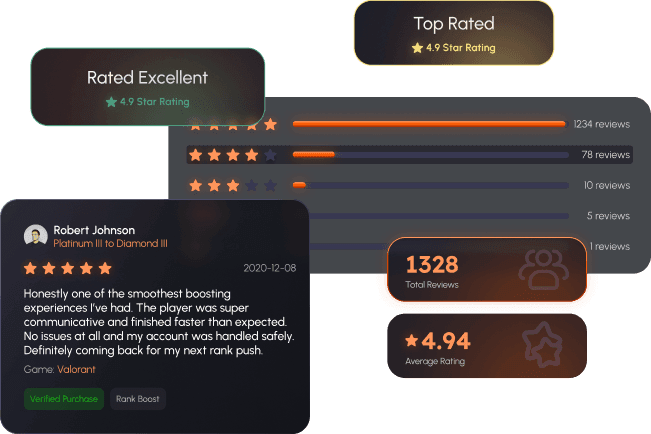
Reviews are the part of this that customers drive, and they are load-bearing. A review is tied to one order, written by the customer who bought that order, and every fact about what is being reviewed — the game, the service, the booster — is read from the order rather than from the form. There is no way to review an order you did not buy and no way to rate a booster you were never assigned.
Every review is moderated before it appears publicly. Moderation removes abuse, personal data and anything that identifies an account, and that is the whole of it. A low rating with a reason is published exactly like a high one. The rating attaches to the booster who did the work at the moment it is written and stays attached even if they later change their display name, because it belongs to the order rather than to the name on it.
On the booster's side that rating feeds a running average, a review count and a completion rate whose denominator is every order ever assigned to them rather than only the ones they finished. An order taken and then handed back counts against that rate permanently. It is why boosters care about the review prompt your dashboard sends after an order, and why a review describing what actually happened is worth more to everybody than a reflexive five stars.
Disputes and refunds, from both sides
An order can be disputed, and a disputed order is treated as an open obligation rather than a closed file. It stays in the customer's active list, nothing about it is purged while the dispute runs, and the booster's access to the account ends immediately, because a dispute is exactly the moment access should stop rather than continue.
Refunds follow the money rather than the mood. A refund reverses the earning that the refunded payment funded and nothing else: a refunded purchase does not claw back a tip the customer separately chose to give, and a refunded add-on does not disturb the main order's earning. Cancelling an order is not the same as refunding one, and cancelling on its own voids nothing. That bookkeeping exists so a customer can get back exactly what they are owed without a booster losing money they were separately and correctly paid.
Where the customer is right and the booster did the work anyway, an operator can record a compensation for them with a written reason attached. It is a decision made by a person and kept on the record, not a rule that fires quietly.
Why boosters are paid after completion
An earning is recorded the moment the money funding it arrives, and then waits. It becomes drawable when the order completes, and tips and add-ons wait for the same moment. Completion is also the point after which the figure stops being editable: the earning is written from whatever terms were in effect at that instant, and nobody revises it afterwards, because by then it has been promised.
When a booster withdraws, they choose which cleared entries to draw rather than typing an amount, so what is granted is exactly what was asked for.
The person working on your order has not been paid yet, and finishing quickly and badly does not pay them. The completion that pays them is the one you accept.
Where to go next
If you play at a level you can prove and want to do this for a living, the application and the current openings are on the jobs page. For the output of everything above, read the reviews customers left on real orders, or how the account-safety process works on the safety page.